
Approve custom printed inserts for wholesale baby toys only when the written specification, physical sample and production release identify the same revision. Verify the insert’s purpose, fit, material, print content and placement; keep product instructions distinct from promotional copy. The practical outcome should be a signed evidence file showing what was checked, what was observed and which conditions were closed—not simply an email saying the artwork looks good. Treat this as a purchasing control, not a safety certification.
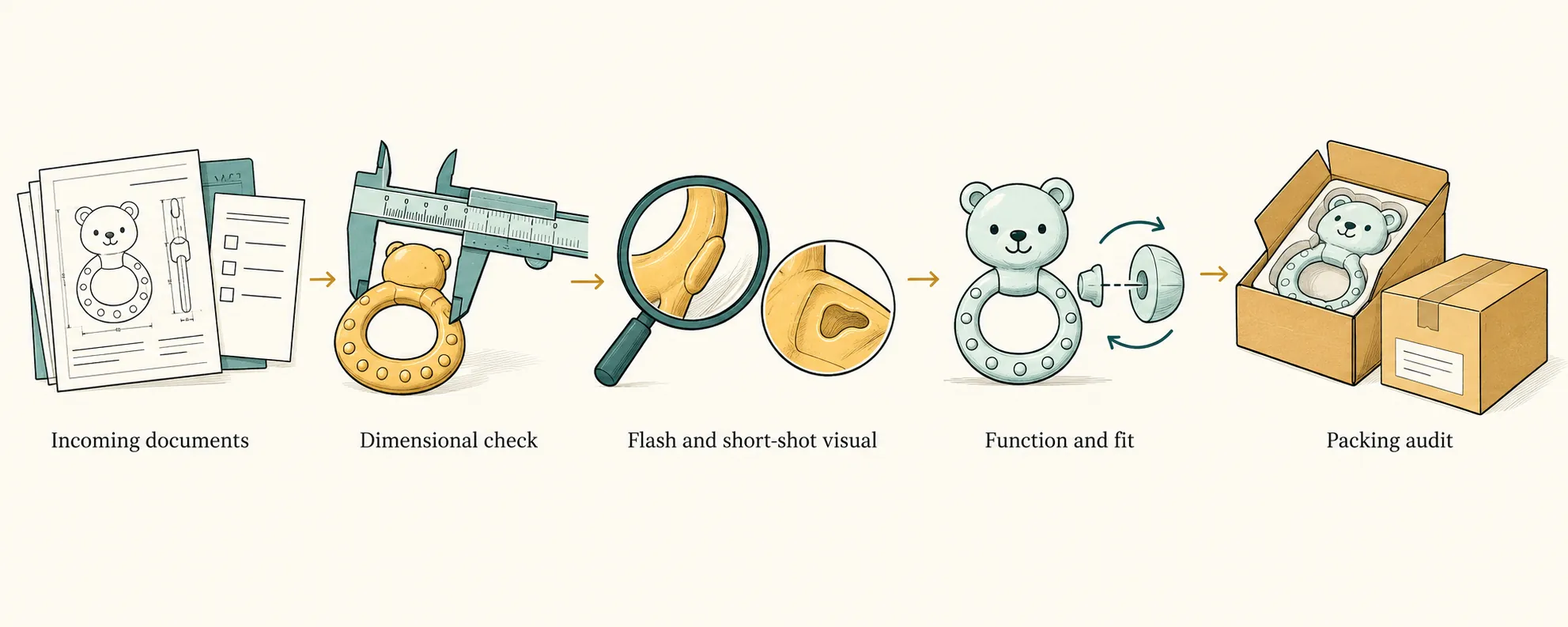
What customization scope and technical inputs must be fixed in writing?
Define whether the order covers a loose information card, a folded instruction leaflet, a structural printed insert or a combination before requesting the production quote. These are different deliverables: approving text on a card does not approve a structure intended to hold the toy.
For each component, specify finished dimensions and units, flat and folded format, material grade and thickness, print sides, colors, finish, cuts, folds and intended position inside the retail box. Identify the exact toy revision, accessories and box format used for fit approval. Use measured samples and a box drawing; do not treat a catalog product dimension as the available space inside its packaging.
Confirm the printer’s submission requirements for the artwork, dieline, fonts, images, bleed and color references. One supplier accepts PSD, PDF and JPEG submissions, illustrating why accepted file formats should be confirmed for the actual printer rather than assumed to be universal. File acceptance alone does not establish that the artwork is ready for production. Toy Box Insert Cards
Request a dated quote tied to this specification revision. Have it identify quantity, sampling and revision charges, tooling or setup charges where applicable, finishing, pack-in responsibility, and the event that starts the agreed production schedule.
How should product instructions be separated from promotional material?
Keep use, assembly and care instructions in a clearly identified content section, separate from brand stories, offers and other promotional messages. If both share one card, distinguish them through labeled panels or an unmistakable reading order and approve each content section separately.
Have the product-content reviewer check instructions against the exact toy and intended use. Have the commercial reviewer approve promotional copy without rewriting those instructions. Record the destination and language version so an approved translation cannot be paired accidentally with another market’s artwork.
Treat supplier descriptions such as “baby-safe,” “protective” or “recyclable” as claims to substantiate before printing them—not as approved insert copy. Infant suitability must follow product-specific age and intended-use evidence, not the catalog category, material name or imagery.
Does approving the artwork also approve insert fit?
| Digital artwork proof | Approve wording, language, graphics, orientation and placement against the controlled artwork file. Do not use this approval alone to accept physical fit, actual color or the finished surface. |
|---|---|
| Unprinted structural sample | Check dimensions, folds, cutouts, insertion and box closure with the identified toy and accessories. Record the sample material; if it differs from production material, limit what this approval covers. |
| Printed pre-production sample | Compare text, print placement, color and finish with the approved references. Assemble it in the intended retail box and check readability, removal and contact with the toy. |
| Production release | Confirm that the accepted content and physical sample correspond to the same final revision, with release-blocking conditions closed and signed. |
What makes a sample approval checkable?
A checkable approval identifies the sample, its specification revision, the acceptance target, the observed result and the person authorized to decide. Retain the signed proof and an identified physical reference sample where practical; photographs supplement the record but do not substitute for checking the assembled pack.
For example, suppose a printed card matches the approved text but catches under the retail box closure. The appropriate decision is “content approved; physical fit not approved,” not a blanket approval. Record the interference, assign responsibility for the correction and require a revised fit sample before production release. This is an illustrative decision, not a reported test result.
If a subsequent card is trimmed to resolve the interference, check the revised dimensions, text clearances and assembled fit. Carry forward unaffected approvals only when the reviewer records why they remain applicable. A revision record supports traceability; it cannot by itself detect an undisclosed substitution.
What changes should trigger re-approval before production?
Make written re-approval a purchase-order condition for changes to material, thickness, finish, printing, dimensions, folds, cutouts or box format. Changes to instructions, translation, intended placement or the packed toy configuration also need review before release.
Assess the affected approval rather than repeating every check automatically. A wording correction needs a new content proof and a layout check. A material or dimensional substitution needs renewed physical review. A box-format change calls for another assembled-pack check even if the card artwork is unchanged.
Require the change request to state the old and proposed specifications, reason, affected files and samples, and any price or schedule impact. Identify the replacement revision and withdraw superseded production files. Ask the responsible product-safety reviewer whether the change affects existing evidence; neither a universal report expiry nor an automatic new test for every internal item code is a sound purchasing rule.
Which records should be complete before production release?
| Order and revision identity | Record buyer order reference, supplier, product identifier and revision, insert identifier and revision, retail-box revision, destination market, language version and review date. |
|---|---|
| Customization specification | Attach the controlled drawing and specification covering insert type, dimensions and units, material, thickness, print sides, colors, finish, folds, cuts and pack-in position. Enter specified targets alongside sample observations. |
| Artwork and content | Record the final artwork filename and revision, dieline revision, printer acceptance and proof reference. Identify separate approvals for product instructions and promotional copy, including each reviewer and approval date. |
| Sample identity and construction | Identify the reviewed physical sample, production-intended materials and any sample-only differences. Record the toy, accessories and box used during review. |
| Acceptance results | For each agreed check, record target versus observation: fit, box closure, insertion and removal, readable content, print placement, color reference and finish. Attach measurement notes or photographs as appropriate. |
| Commercial confirmation | Attach the dated quote linked to the approved specification. Confirm order quantity, charges, sampling scope, revision terms, pack-in responsibility and the agreed production-schedule trigger. |
| Product and destination evidence | File product-specific age and intended-use evidence, approved destination text and the documents identified by the responsible product-safety or regulatory reviewer. Record which product construction and version each document covers. |
| Changes and unresolved conditions | List each change or open condition, affected approval, release-blocking status, responsible owner, required action and due date. Record closure evidence, closure reviewer and closure date. |
| Final release decision | Enter approved, approved with stated conditions, or not approved. Define exactly what activity is authorized, identify the final production revision, and record the responsible approver’s name, role, signature and date. |
| Supplier acknowledgment and handoff | Obtain acknowledgment of the released files, sample reference and no-substitution condition. Record who received the production package, the acknowledgment date and withdrawal of superseded files. |
What does an approved insert file not establish?
An approved insert file establishes the scope of the recorded purchasing acceptance—not infant suitability, safety certification or regulatory compliance by itself. A catalog entry likewise does not establish certification, stock availability or factory capacity.
Keep the release decision precise. If content is accepted but physical fit remains open, authorize only the stated correction or sampling activity, not mass production. Once the condition closes, sign the release against the final revision and hand that same package to production.