
Choose direct shipment for ready-to-ship baby-toy orders that cannot wait for other suppliers; choose warehouse consolidation when coordinated multi-supplier arrivals matter more than avoiding extra warehouse handling. For baby toy shipping volume and carton planning, compare the route at carton level, not just the number of freight bookings. Consolidation adds receiving and dispatch touches; repacking adds another operation only if specified. Before booking, require a carton-to-SKU/lot link that survives every handoff, plus a named owner for closing discrepancies.
The comparison below covers supplier-direct exports versus consolidation at an origin warehouse, using China-origin sourcing as the reference. Direct shipment means bypassing that consolidation warehouse—not bypassing carrier hubs, ports, or other transport handling.
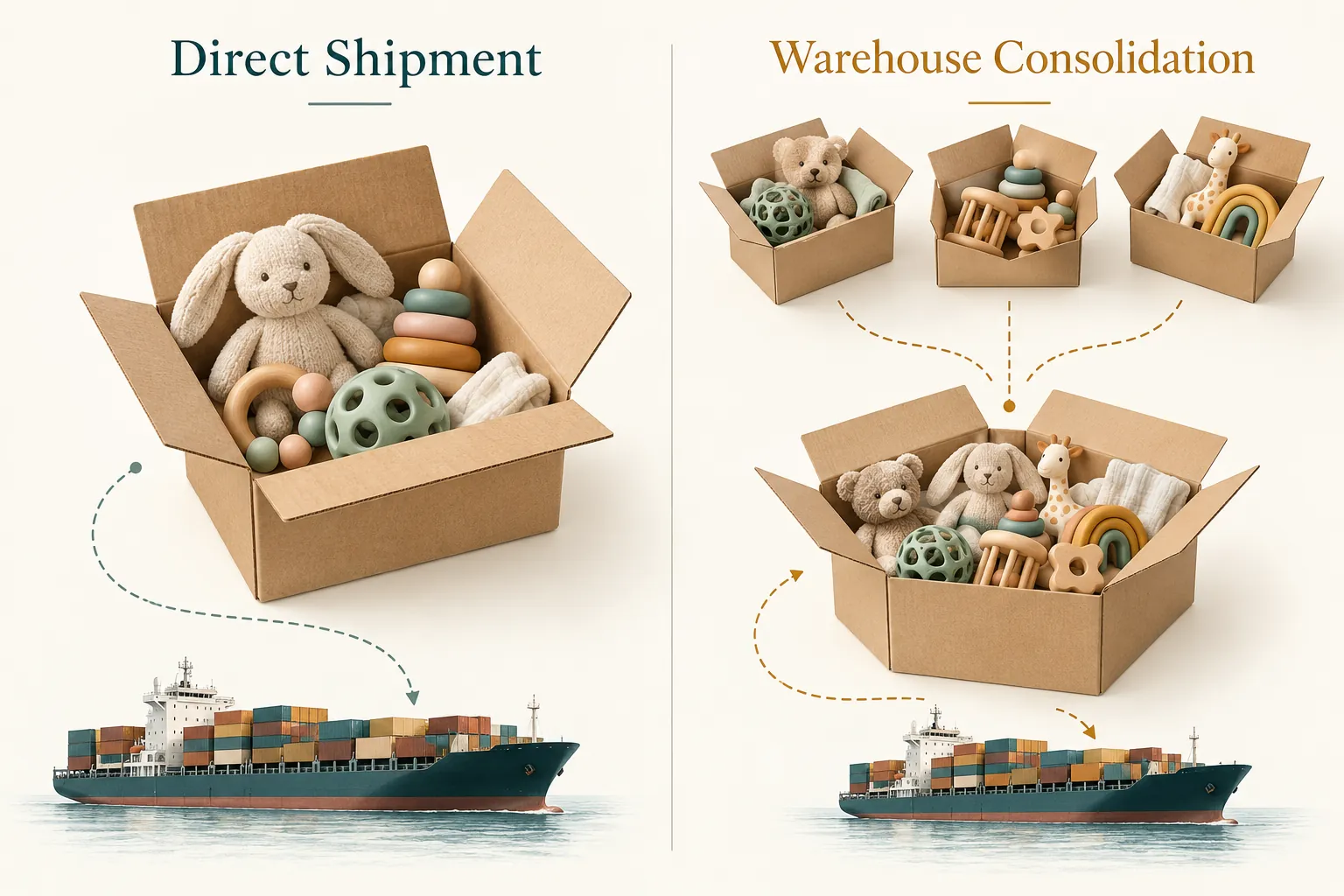
What changes between direct shipment and warehouse consolidation?
| Routing | Direct: each supplier dispatches separately toward the buyer's destination. Consolidation: suppliers first dispatch to an origin warehouse, which combines cargo for international shipment. |
|---|---|
| Carton handling | Direct: avoids the origin consolidation warehouse's unload and reload. Consolidation: adds warehouse receiving and outbound loading; opening, sorting, or repacking must be specified separately. |
| Dispatch readiness | Direct: a ready supplier can dispatch without waiting for the other suppliers. Consolidation: release depends on the agreed collection cutoff and which supplier orders must be included. |
| Traceability structure | Direct: retain separate supplier packing lists and transport references. Consolidation: retain those inbound records and link them to the outbound manifest; a combined booking does not replace the supplier-level records. |
| Destination receiving | Direct: plan for separate supplier arrivals. Consolidation: specify a coordinated receiving plan, but confirm whether the booked service actually provides one delivery appointment. |
| Commercial comparison | Compare complete direct-route charges with supplier-to-warehouse transport, warehouse services, consolidated transport, and destination delivery. Consolidation does not automatically guarantee lower total cost. |
How many handling events should the buyer count?
| Factory dispatch loading | Direct: 3 events. Consolidation: 3 events. Required record: supplier packing list linking carton ID, SKU, quantity, lot reference, and destination to the dispatch reference. |
|---|---|
| Origin consolidation-warehouse unloading | Direct: 0 events at this warehouse. Consolidation: 3 events. Required record: inbound transport reference, receiving date, original carton IDs, received quantities, visible condition, and any discrepancy. |
| Opening or repacking | Direct: none specified. Consolidation: none specified in this example. If added, record the work separately and create an original-carton-to-new-carton mapping before release. |
| Consolidation-warehouse outbound loading | Direct: 0 events at this warehouse. Consolidation: 3 events. Required record: outbound manifest linking all three original carton IDs to the combined shipment reference. |
| Destination unloading | Direct: 3 events across separate supplier consignments. Consolidation: 3 events under the combined shipment. Required record: delivery receipt linked to the manifest, with carton-count and visible-condition exceptions. |
| Bounded endpoint total | Direct: 6 carton load/unload events. Consolidation: 12 carton load/unload events. Both plans keep 3 sealed cartons; consolidation reduces separate international consignments in this example, not the carton count. |
| Unit-level handling | Neither plan specifies opening retail packs or handling individual toys. Do not count this as proof that no such handling occurred; record any authorized opening, sorting, inspection, or repacking separately. |
What traceability must survive consolidation or repacking?
Every outbound carton should remain linked to its supplier, SKU quantities, and applicable lot references, even when its outer carton or transport reference changes.
Specify carton marks identifying the SKU, quantity, destination, handling information, and lot or shipment reference. Where one SKU spans factories or lots, preserve that split in the order and carton coding rather than hiding it behind a single SKU total.
For direct courier parcels, retain each parcel's tracking reference beside its supplier packing list. Freight2me's 2026 description uses one tracking number per direct parcel and describes an optional consolidation service that repacks supplier parcels into one carton. That is a service configuration, not a rule that every consolidated shipment becomes one carton or one tracking number. Freight2me
If repacking is authorized, request a mapping showing original carton ID, supplier, SKU, lot, quantity transferred, new carton ID, and any balance or discrepancy. A new label without that mapping can make the contents harder to trace. A record supports traceability; it does not by itself detect an undisclosed substitution.
Warehouse receiving checks are not professional product quality control. An intact carton count, a photograph, or a receiving signature does not establish baby-toy safety or product quality. JW Logistics
How do shipping volume and carton readiness affect the choice?
| 6 Math Matching Eggs | Catalog packing reference: 120 units per carton. Reconfirm the packing configuration for the shipment being booked. |
|---|---|
| Early-education toy set with silicone cover | Catalog packing reference: 48 units per carton. Reconfirm the packing configuration for the shipment being booked. |
| Volume inputs for either route | Request carton count, external length × width × height, gross weight, and any pallet dimensions. Compare the carrier's applicable dimensional-weight or freight-rating method rather than assuming a universal divisor. |
| Intact-carton consolidation | Combines transport bookings without necessarily reducing carton count or packed volume. Specify whether original cartons and labels remain unchanged. |
| Repacked consolidation | Compare the proposed final dimensions and gross weight with the original packing plan. Authorize changes only after reviewing product protection, retail-pack condition, and the carton-to-SKU/lot mapping. |
| Mixed-SKU cartons | Require a contents breakdown by SKU, lot, and quantity for each outer carton. Confirm that destination receiving can process that configuration before authorizing it. |
Which constraint should drive the route selection?
| One supplier; shipment-ready cartons; no central preparation needed | Choose direct shipment to avoid an unnecessary consolidation stop. The supplier must deliver the agreed carton marks, packing list, and destination-ready packaging. |
|---|---|
| Several small supplier orders; coordinated receipt is the priority | Choose consolidation if the destination service can meet the receiving plan. Accept the extra warehouse unload/reload and require inbound-to-outbound carton mapping. |
| One urgent supplier order; other orders are not ready | Send the urgent order directly and consolidate the remainder. Preserve separate order-line and carton references so the split does not obscure quantities or lots. |
| Packaging or labels need centralized correction | Choose consolidation only with an agreed work instruction and release record. Receiving cargo at a warehouse does not automatically authorize relabeling, opening, or repacking. |
| Original sealed-carton identity is the priority | Prefer direct shipment when no warehouse service is needed. If consolidation is required for coordinated delivery, specify intact-carton handling and retain the original carton IDs. |
| Destination cannot process mixed-SKU cartons | Keep single-SKU cartons under either route. Do not approve repacking merely to reduce the number of outer cartons. |
What should the buyer verify before booking?
Release the booking only after the selected route's handling plan, carton identity, receiving arrangement, and discrepancy owner are agreed.
For the hypothetical three-supplier example, consolidation is the proposed choice because coordinated receipt is the stated priority and all three cartons are assumed ready. Its twelve counted endpoint events are accepted in exchange for a combined dispatch; no freight saving or delivery-time improvement is assumed. The following is an illustrative approval record, not a completed shipment.
| Order identity and revision | Illustrative order: Three-Supplier Baby-Toy Shipment; route worksheet revision 1; planning date October 27, 2026. Scope: 3 suppliers, 3 sealed cartons, one destination. |
|---|---|
| Specified target versus planning observation | Target: coordinated destination receipt, original cartons retained, and SKU/lot identity preserved. Planning observation: the intact-carton consolidation layout adds 6 counted endpoint events versus direct shipment; readiness and label correctness are assumptions to confirm before release. |
| Decision and conditions | Conditional selection: warehouse consolidation without repacking. Require an inbound receipt for each original carton, an outbound manifest linking all three cartons, and confirmation of the destination appointment arrangement. |
| Carrier-route confirmation | Logistics coordinator: obtain the planned transfer and handling points outside the bounded example, identify the transport references for each leg, and update the comparison if the actual service adds a destination warehouse. |
| Responsible approver and review date | Proposed approver: buyer's logistics manager. Illustrative review date: October 27, 2026. The actual booking release must carry the responsible person's name and dated approval. |
| Follow-up and closure | Before booking, attach the warehouse's intact-carton instruction acceptance, carton-ID mapping format, and receiving confirmation. Record the closure owner, date, and document reference for each condition. If a condition cannot be met, revise the plan or route the affected supplier order directly and recalculate the handling comparison. |