
Prepare a baby toy order change request by recording the approved baseline, the exact proposed difference, affected quantities and records, and the named approval owner before authorizing implementation. A request is ready for review when its scope is traceable and every unresolved check has an owner and a release condition. For buyers managing how to source baby toys in bulk, the practical outcome is a written change package—not a revised instruction buried in email.
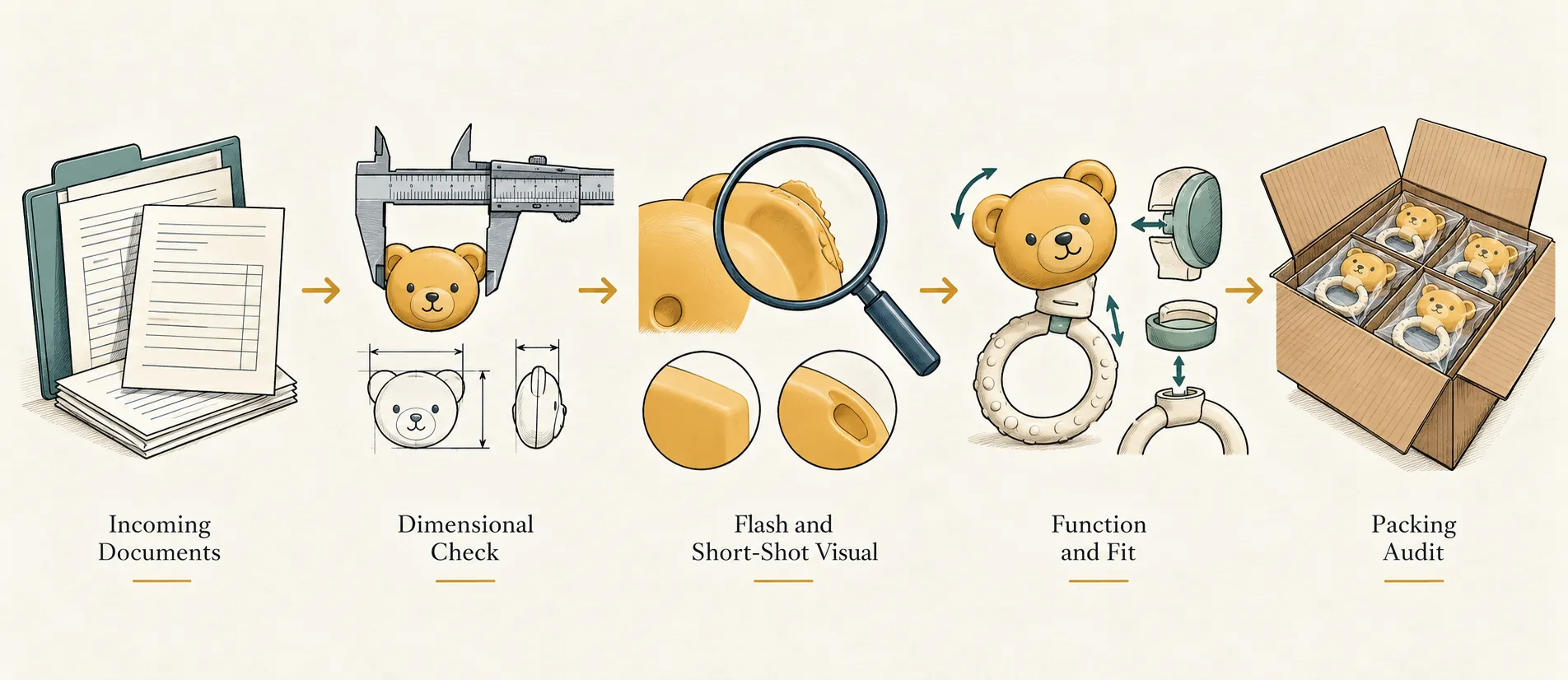
What should the buyer verify before drafting the change request?
Verify which approved order version governs the work and how far the affected goods have progressed before proposing a change.
Start with the purchase order and its amendments, approved specification, sample sign-off, artwork, and current commercial agreement. Identify each affected item by the buyer’s and supplier’s item references, order line, revision, quantity, and destination market. State exclusions explicitly: a change to one retail box does not automatically authorize changes to the toy, instructions, or other order lines.
Ask the supplier to confirm the current stage of the affected quantities: materials committed, production underway, finished, packed, or dispatched. Request the proposed implementation point and treatment of existing work. Do not assume that an instruction sent today can apply to everything already ordered.
Use this purchasing sequence: establish the baseline; describe the requested difference and reason; obtain supplier feasibility and commercial impacts; route the package for review; issue the approved amendment; then verify implementation and close the request. A change request is not, by itself, permission to proceed.
Who owns the decision and who must approve the change?
Name one buyer-side decision owner, then require approval from the functions whose responsibilities the proposed change affects.
The purchasing or category manager can coordinate the request and approve commercial terms within their authority. Quality or compliance should review changes affecting construction, age claims, warnings, instructions, or the relevance of existing testing. Packaging or brand owners should approve artwork; logistics should confirm changes affecting packing, shipment records, or delivery arrangements.
The supplier’s named coordinator should confirm feasibility, the implementation point, and the documents issued to production. Supplier acceptance does not replace buyer approval, and a buyer’s commercial approval does not resolve an outstanding technical review.
Record actual names, roles, and required sign-offs—not just department names. This is a recommended purchasing control, not a universal statutory approval structure.
What belongs in the change scope and impacted-records register?
| Request identity and revision | Assign a change-request reference, revision, issue date, requester, supplier, and related purchase order. Retain superseded versions rather than overwriting the history. |
|---|---|
| Affected goods and boundaries | List item references, order lines, affected quantities, destination markets, and applicable lots or production stages. State which goods and features are excluded. |
| Approved target versus observation | Quote the current approved requirement and its document reference. Describe the requested replacement separately from what the supplier’s proof, sample, or production record actually shows. |
| Reason and implementation point | Explain why the change is requested, when it should take effect, and how existing materials, work in progress, finished goods, and obsolete packaging will be handled. |
| Specification and bill of materials | Identify affected drawings, component descriptions, material specifications, and revisions. Record the technical reviewer’s disposition even when no revision is needed. |
| Sample and inspection records | Reference the approved sample or proof and its sign-off. Identify any replacement reference sample, inspection instruction, or acceptance criterion needed to verify the change. |
| Artwork, labels, and packing | List affected retail-box files, instructions, warnings, barcodes, carton marks, packing instructions, and related revisions. Identify the approved master file. |
| Age, intended use, and destination documents | Link the item-specific age and intended-use evidence, relevant test reports, certificates, and market documentation. Assign a reviewer to determine whether the proposed change affects their coverage or content. |
| Commercial and shipping records | Record the supplier’s confirmed cost and schedule impacts, revised quotation, purchase-order amendment, and any affected packing list, invoice, or booking instructions. |
| Evidence status and open checks | Mark each conclusion as confirmed, assumed, or open. Give every open check a named owner, due date, required evidence, and approval or release consequence. |
| Decision and authorization | Record approve, approve subject to stated conditions, return for revision, or reject. Capture the responsible approver’s name, role, date, and the exact request revision authorized. |
| Implementation and closure | Record supplier acknowledgment, the actual implementation point, updated-document distribution, verification results, and any remaining action. Identify the person and date responsible for closing each action and the request. |
Which evidence needs special attention for baby toys?
Check item-specific age, intended-use, and destination documentation whenever a proposed change could alter the product or the claims made about it.
A catalog category, photograph, or material description does not establish infant suitability. Use the approved item-specific records, and ask the technical reviewer to assess the proposed difference against them. Do not treat a change in wording from an older age group to a younger one as a routine artwork edit.
For US children’s products requiring a Children’s Product Certificate, CPSC identifies the domestic manufacturer or importer as the certifier and specifies information concerning the test-record holder, manufacture, testing, and CPSC-accepted laboratory. Request the actual file and check product identity, responsible parties, and dates rather than accepting the word “CPC” in a catalog. CPSC CPC guidance (Guidance checked October 9, 2026.)
The document review should determine whether existing evidence covers the changed construction and applicable requirements. Neither a new internal revision nor an unchanged product name answers that question automatically. Keep the relevant material, production, inspection, change-control, and testing records accessible for the buyer’s market and recall needs; this workflow does not prescribe a universal retention period.
How should confirmed facts, assumptions, and open checks differ?
| Identity and requested scope | Illustrative request CR-ART, revision B: relocate the barcode on one identified order line’s retail box. The live request must attach the purchase-order reference, affected quantity, destination, and approved artwork revision. |
|---|---|
| Specified target | Place the barcode in the designated artwork area without covering warning text. Retain the approved warning wording, age marking, box dimensions, and toy specification. |
| Observed proof — confirmed | The revised digital proof shows the barcode overlapping the warning panel. Attach that proof and identify its revision; do not record it as an approved production file. |
| Commercial assumption | The requester expects no price or shipment-date change. Treat that expectation as an assumption until the supplier provides written confirmation or a revised quotation. |
| Open checks and owners | Packaging owner: obtain a corrected proof and approve placement. Supplier coordinator: confirm affected packaging quantities and implementation point. Purchasing owner: confirm commercial impacts. Assign names and due dates in the live request. |
| Review decision and closure | Return the proof for correction; do not release the revised artwork. The purchasing decision owner records their name and review date. Close only after the corrected proof is signed, commercial impacts are accepted, and the supplier acknowledges the authorized file and implementation point. |
When is the request ready for approval, and when must work stop?
Submit the request for review when the scope, baseline, evidence references, owners, and unresolved conditions are explicit; authorize implementation only after the applicable release conditions are satisfied.
Open feasibility questions can accompany a request for review. They must not be presented as settled facts. If an unresolved issue affects a decision, route the request for clarification or conditional review—not unconditional release.
Specify the affected activity to hold: for example, use of the revised artwork, substitution of a component, packing of identified goods, or shipment of the affected quantity. Set a stop condition when the baseline cannot be identified, required technical review is incomplete, commercial impacts remain unaccepted, or production is using a revision that differs from the authorized one. Do not automatically hold unrelated order lines without a reason.
After approval, issue the controlled amendment and replacement documents, withdraw superseded instructions from use, and obtain supplier acknowledgment. Verify the agreed implementation point against the relevant proof, sample, inspection record, or production record. A signed request supports traceability; it does not by itself detect an undisclosed substitution.
The handoff is complete when the named decision owner has dated the decision, every release condition has evidence of closure, and the supplier has acknowledged exactly what will change and where. That is the difference between requesting a change and controlling one.