
Release a baby toy shipment for warehouse receiving only after the buyer has approved measured packaging data, carton labels and reconciled count expectations against the current order revision. Baby toy shipping volume and carton planning should begin with preliminary estimates but finish with the actual packed configuration. Issue the purchase order with clear packaging requirements; make final shipment release a separate approval. The warehouse should receive the same approved record as the supplier, including any open conditions and their owners.
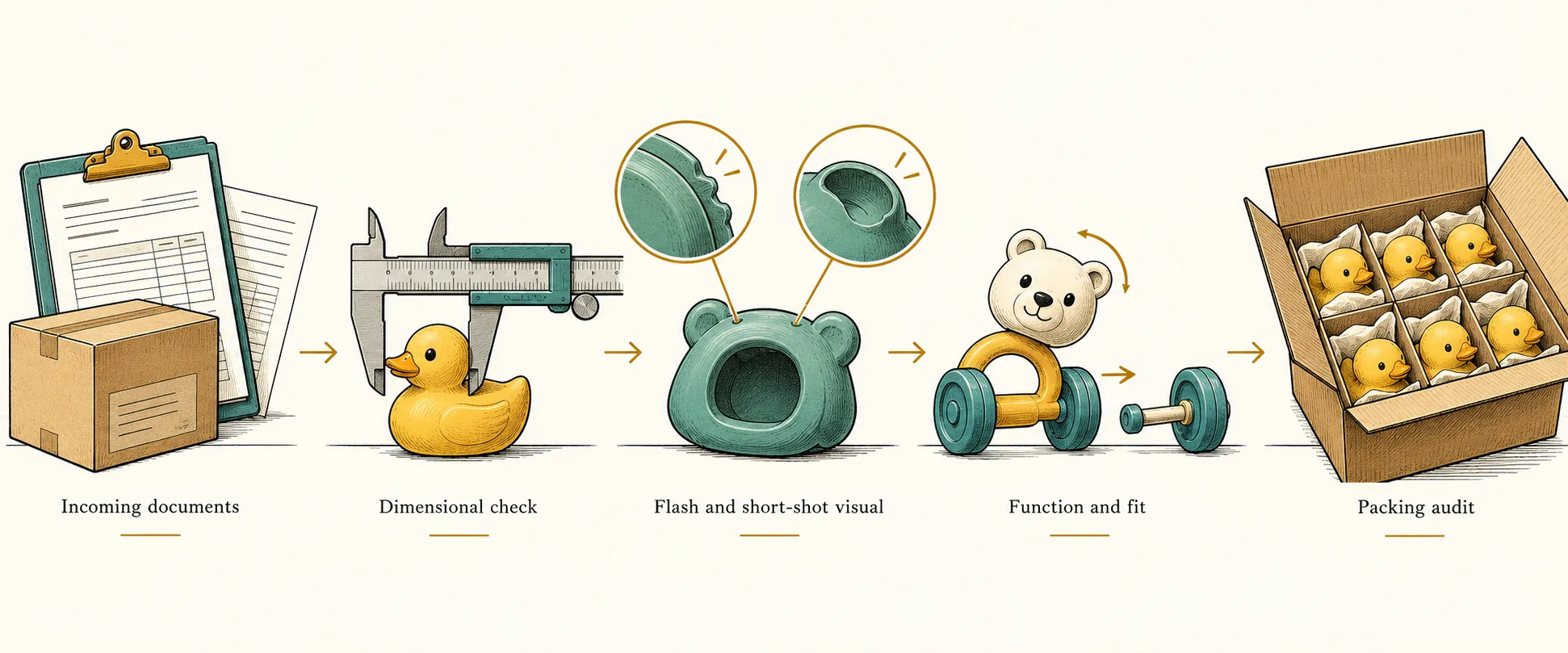
What should the buyer confirm before releasing a baby toy order?
The buyer should confirm product identity, packed dimensions, packing quantities, label content and shipment totals, with one named purchasing lead responsible for final release.
Before issuing the purchase order, purchasing collects the product specification, SKU-specific age and intended-use evidence, proposed packing configuration and the destination warehouse’s labeling instructions. The warehouse lead approves identification and booking requirements; the supplier confirms how the goods will be packed. Preliminary dimensions can support planning, but should be marked as estimates rather than approved receiving data.
After production packaging is available, the supplier provides measurements and packing evidence. Validate the carton sample with the actual toy, inserts, labels and accessories—not an empty box. Quality or packaging personnel review the assembly, while purchasing reconciles the resulting configuration with the order.
Keep product-quality approval separate from final quantity and packaging approval. One published novelty-toy case describes a post-production quality check followed by a pre-shipment check of quantities, packaging and condition. That is a useful process distinction, not a mandatory standard or evidence about baby-toy carton capacity. Toy shipment case study
What belongs in the pre-shipment verification record?
| Order identity and revision | Required input: purchase order, supplier, destination warehouse, product-data revision, packing-specification revision and label-artwork revision. Confirmation: compare the supplier’s acknowledgment with the buyer’s controlled documents. Stop condition: conflicting versions or an unidentified shipment. Purchasing resolves the conflict and distributes the approved revision. |
|---|---|
| Product identity, age and intended use | Required input: buyer and supplier product identifiers, description, variant, unit of measure, and SKU-specific age and intended-use evidence. Confirmation: match documents and the approved sample to the ordered item. Stop condition: unresolved identity or age/intended-use mismatch. The designated product or quality approver resolves the issue before release; category names, material descriptions and imagery are not substitutes. |
| Measured packaging and shipping volume | Required input: packed retail-unit dimensions, outer shipping-carton dimensions, units of measurement and gross carton weight. Confirmation: dated measurements of production packaging, with the packing revision identified. Stop condition: only preliminary artwork dimensions are available for final receiving approval, or measured results conflict with the accepted specification. The packaging reviewer confirms corrections; purchasing approves the revised handoff. |
| Inner packs and carton quantities | Required input: sellable units per inner pack, inner packs per carton where used, and sellable units per full carton. Confirmation: packing evidence from the actual configuration. Stop condition: inconsistent counting units or disagreement between packing evidence and the packing list. The supplier reconciles the figures; purchasing approves the corrected record. |
| Complete carton assembly | Required input: carton construction and the actual toy, inserts, labels, accessories and closure method. Confirmation: documented review of the assembled pack against the approved specification. Stop condition: the assembly has not been validated, or a material substitution remains unreviewed. The packaging or quality approver records the required review and its disposition. |
| Carton labels | Required input: agreed product identifier, packed quantity and counting unit, purchase-order reference, carton identifier or sequence, destination, and batch/lot information where specified. Include handling symbols and warning content only as applicable to the approved instructions. Confirmation: approved artwork plus an applied-label sample; check scan readability if barcodes are used. Stop condition: missing, incorrect, unreadable or conflicting agreed fields. The warehouse lead approves the corrected label and application evidence. |
| Shipment totals and tolerances | Required input: ordered and declared shipped units by product, full and partial carton counts, mixed-carton contents where permitted, and the agreed over/under tolerance. Confirmation: reconcile the packing list with the order and packing evidence. Stop condition: an unexplained difference or variance outside the agreed allowance. Purchasing decides whether to correct the shipment or approve a documented order amendment. |
| Release decision and closure | Required input: release, hold or conditional-release decision; approver name and role; decision date; approved specification revisions; and any conditions. Confirmation: signed or otherwise controlled approval record. For each condition, record the affected quantity, containment, responsible owner, required evidence, closure date and closing approver. Stop condition: no authorized disposition for an open release-critical issue. |
How should measured cartons change the receiving plan?
Use measured outer-carton dimensions for the final volume estimate, and retain preliminary dimensions only as a clearly identified planning baseline.
For a rectangular carton, calculate external volume as length × width × height using consistent units. Sum the volumes of the actual carton configurations; do not apply one full-carton size to every partial or differently packed carton without checking. Gross weight is a separate input. A cubic-volume total alone does not establish pallet positions, stacking suitability or handling access.
Consider this bounded comparison: the purchase order was planned from packaging artwork, but the completed pack needs a different insert arrangement. If the supplier measures and validates the revised assembly, the warehouse can review the new dimensions and count configuration before shipment. If the supplier sends only revised artwork, retain the estimate for planning and hold final packaging approval until the packed sample is checked.
A carton-board substitution also needs review even if the description still says “double-wall.” A supplier-specific board-grade reference, checked October 21, 2026, lists different calipers for BC and EB constructions. Treat a substitution as a reason to recheck fit and compression against the agreed packaging criteria—not as proof of equivalent performance. Board Grades reference
How should count expectations and tolerances be agreed?
State count expectations in sellable units by product, then reconcile those units to the declared inner packs, full cartons, partial cartons and shipment total.
Choose exact quantities when the warehouse or allocation plan requires them. Allow an over/under tolerance only when purchasing has explicitly accepted it and the warehouse can process the resulting difference. Define its basis—per product or across the shipment—and how any percentage allowance converts to whole units. A shipment-wide allowance should not silently authorize shortages on one product offset by excess on another.
Keep the quantity allowance separate from labeling accuracy. An approved shortage does not justify labeling a partial carton as full. For example, a shipment within an agreed unit tolerance can still require a hold if its carton labels show the planned quantity rather than the packed quantity. Correct the labels and packing list before release, or obtain a specific, controlled exception from the warehouse lead.
A carton quantity describes a packing configuration; it does not automatically require full-carton ordering. If partial cartons are permitted, identify their actual contents and quantities. Do not round up the purchase order merely because the catalog lists units per carton.
Who approves release, and how should open conditions close?
The named purchasing lead should authorize shipment release after the relevant product, packaging and warehouse reviewers have resolved their assigned conditions.
For every stop condition in the verification table, record the affected order and specification revision, observed discrepancy, decision, approver and date. A nonconformance record should identify the defect, lot, affected quantity, containment, disposition and responsible decision—not merely say “fail.” Close the condition with evidence such as corrected labels, a reconciled packing list or a reviewed packed sample, followed by a named closing approval.
Use conditional release only for a specific accepted exception with a defined owner and closure requirement. Do not use it to bypass unresolved product identity, age/intended-use questions or an unexplained quantity difference. The approval record supports traceability; it does not itself reveal an undisclosed packaging change.
Attach the approved record to the purchase order and send the warehouse the same revision, packing list, label reference and any appointment information it requires. A missing approval or label mismatch should trigger escalation before unrestricted stock receipt. Where the warehouse permits it, controlled unloading into a hold area can be authorized separately; unloading is not acceptance into available inventory.
This workflow establishes commercial receiving readiness. It does not replace safety testing, market-specific labeling review, customs or duty decisions, freight-mode selection, or the warehouse’s own arrival inspection.