
Choose wooden toy gifts when visible construction and finish are central to your shelf concept; choose soft toy gifts when a tactile, character-led presentation is the priority. For either option, verify written care instructions, the measured retail display footprint and its assigned assortment role before listing. For wooden baby toy wholesale orders, material specifications are only a starting point: they do not establish infant suitability, cleaning methods or shelf fit. Treat supplier descriptions as claims to confirm against documents and samples.
Neither material earns an automatic space advantage. A boxed soft toy can occupy more room than a compact wooden gift, while an assembled wooden display can need substantially different space from its retail pack. Compare the specific products in the format shoppers will actually see.
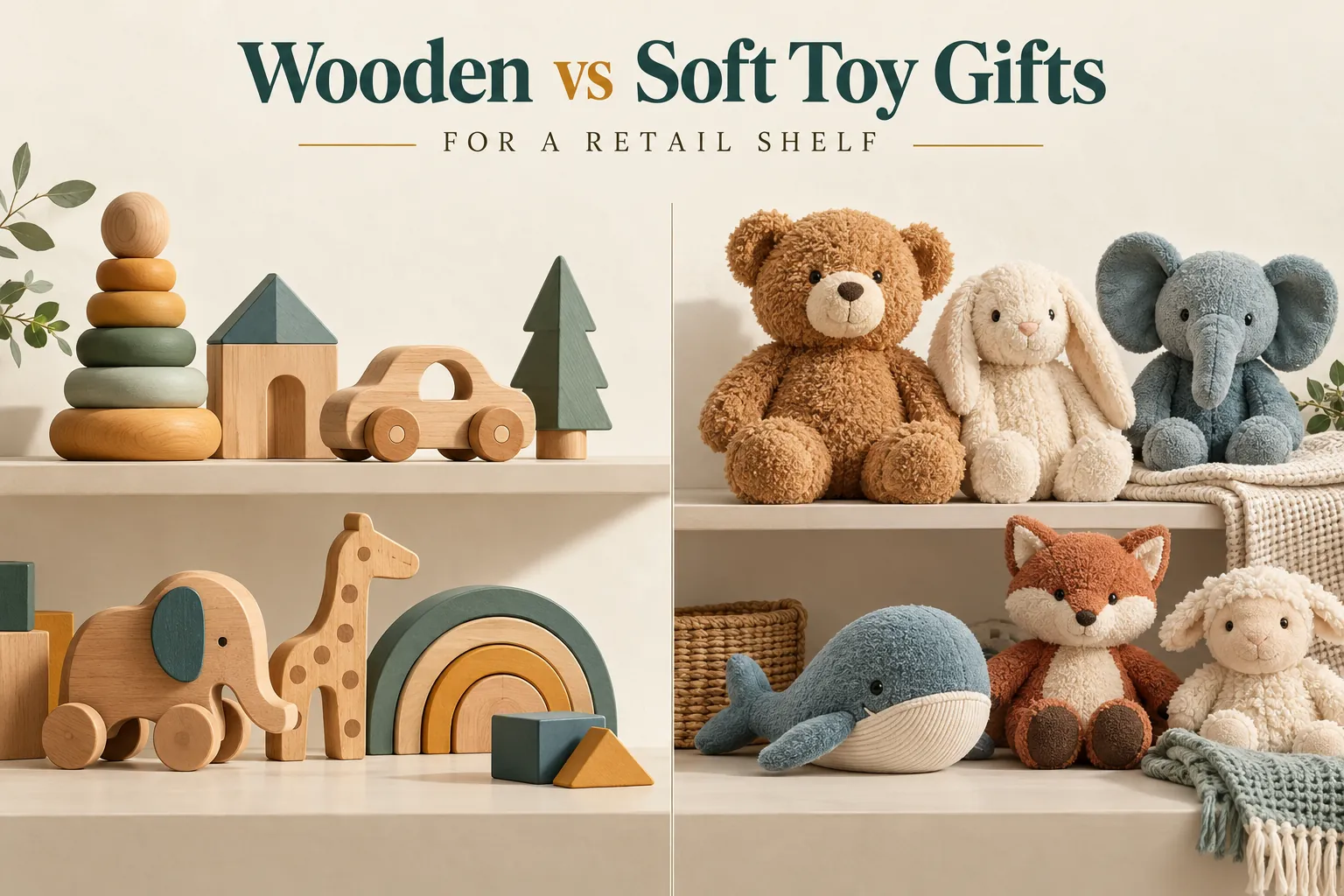
How should wooden and soft toy gifts be compared?
Compare both alternatives against the same care, space and merchandising requirements, rather than assigning benefits from the material name alone. The following are recommended buyer checks, not claims that every wooden or soft toy has these characteristics.
| Care disclosure | Wooden: request cleaning and drying instructions for the finished toy, including coated surfaces, joints and attached components. Soft: obtain instructions covering the outer fabric, filling, trims and any internal components; confirm whether cleaning is surface-only or washing is permitted. Decision: if your shelf promise includes washable gifts, approve only the product whose finished-toy instructions support that promise. |
|---|---|
| Display footprint | Wooden: measure the retail pack and any assembled display separately, including projecting parts and the proposed stand. Soft: measure the packaged or supported display, including any bin, backing card or holder. Decision: for a shallow shelf, select the candidate that fits in its intended display format—not the one that can be temporarily squeezed or turned sideways. |
| Assortment role | Wooden: consider it for a construction-and-finish-led gift presentation, provided those details remain visible. Soft: consider it for a tactile or character-led gift presentation, provided the display preserves that presentation. Decision: assign each candidate a defined role, such as a feature gift or a compact companion gift; do not assume either material deserves the anchor position. |
What care information should reach the shopper?
Publish the care method for the finished toy, not a cleaning assumption derived from “wooden” or “soft.” Request the proposed care label and check that the packaging, listing copy and supplier instructions agree.
For a wooden candidate, ask which components are solid wood, engineered wood or coated, then confirm the permitted cleaning method for the complete assembly. For a soft candidate, request the outer-fabric and filling description alongside instructions for attached details and internal components. A fabric description alone is not permission to machine-wash the toy.
Keep display maintenance separate from consumer care. If an unpackaged sample will be handled, agree how store staff should clean it without contradicting the product instructions. Where instructions are surface-clean only, say so plainly rather than presenting the gift as washable.
What does a wooden dollhouse specification actually establish?
A wooden dollhouse listing illustrates how material and size disclosures can inform a shortlist without establishing care, baby suitability or shelf fit. The supplier describes one model as solid wood and MDF with “eco-friendly paint,” and gives approximate dimensions of 45 × 35 × 55 cm, customizable. These are supplier-stated product specifications; the paint description does not establish a tested safety property. Dollhouse specification
For a worked shelf comparison, treat that size as a product-size reference only. Request the retail pack dimensions, measure an assembled sample in the proposed orientation and include any stand, signage and handling clearance. Compare the soft candidate in its actual packaging or display holder under the same conditions. Do not enter the dollhouse dimensions as carton dimensions or assume their order defines the displayed width, depth and height.
If the plan calls for an assembled wooden feature but the sample extends beyond the allocated space, reject that display configuration or move it to a suitable fixture. If the soft candidate fits only when compressed and loses its intended presentation when released, reject that configuration too. Shelf fit is a pass-or-revise decision for the proposed display—not a general verdict on either material.
This dollhouse is a specification-reading example, not a recommendation for a baby shelf. Assign age placement only after reviewing the candidate product’s intended use, age grading and applicable supporting documentation.
What should a buyer verify before approving either toy gift?
Approve a candidate only when its identity, shopper-facing care disclosure and actual display arrangement match the reviewed sample and documents.
The dollhouse page lists “EN71 / ASTM / CE / CPSIA” as “available upon request.” That wording is not confirmation that the product is certified or that particular testing covers your order. As a purchasing check, obtain the relevant reports and market documentation, then match their product identification and construction to the candidate being reviewed. Dollhouse specification
Use this record for each shortlisted wooden or soft gift. It supports traceability; it does not by itself detect an undisclosed product change or replace safety assessment.
| Product and revision | Record the product identifier, supplier, sample reference, material specification revision and packaging/artwork revision reviewed. |
|---|---|
| Care target versus observation | State the care promise intended for the listing. Record the supplier’s finished-toy instructions, the sample label wording and any discrepancy requiring correction. |
| Space target versus observation | Record the allocated shelf width, depth and height beside measured retail-pack and display dimensions. Include the proposed holder or stand and retain a photograph of the arrangement. |
| Assortment role and age placement | Specify the intended role and shelf location. Review age grading, intended use, warnings and supporting documents before approving placement in a baby-toy assortment. |
| Decision and closure | Record approve, revise or hold; any conditions; the responsible approver and decision date. Assign unresolved actions to an owner and record closure evidence and date before releasing the affected listing. |
Which option should take the shelf space?
Give the space to the candidate that fulfills the intended gift role while meeting your care-disclosure and measured-fit requirements. Choose wood for a construction-and-finish-led presentation; choose soft for a tactile, character-led presentation—but only where the actual sample and display deliver that distinction.
If both qualify, use the remaining constraint to decide: the required cleaning promise, available shelf depth or the role missing from the assortment. Material alone establishes neither shopper demand nor sales performance, and a commercial shelf check is not safety testing.